[Inside HMG’s Digital R&D Revolution ④] NOVA Lab: How Hyundai Motor and Kia Find Up to 200 Vehicle Issues Before Prototype Exists

Page sharing

Editorials [Inside HMG’s Digital R&D Revolution ④] NOVA Lab: How Hyundai Motor and Kia Find Up to 200 Vehicle Issues Before Prototype Exists

Please use Safari to download the files.

Empty cart?
Next
Prev
이전 페이지

[Inside HMG’s Digital R&D Revolution ④] NOVA Lab: How Hyundai Motor and Kia Find Up to 200 Vehicle Issues Before Prototype Exists

Added to
Media Cart
Copied to
clipboard
URL copied to clipboard

Share via email We do not collect email addresses.

Editorials 202608070800
[Inside HMG’s Digital R&D Revolution ④] NOVA Lab: How Hyundai Motor and Kia Find Up to 200 Vehicle Issues Before Prototype Exists

3 minutes read
Added to
Media Cart
Copied to
clipboard

Share via email We do not collect email addresses.

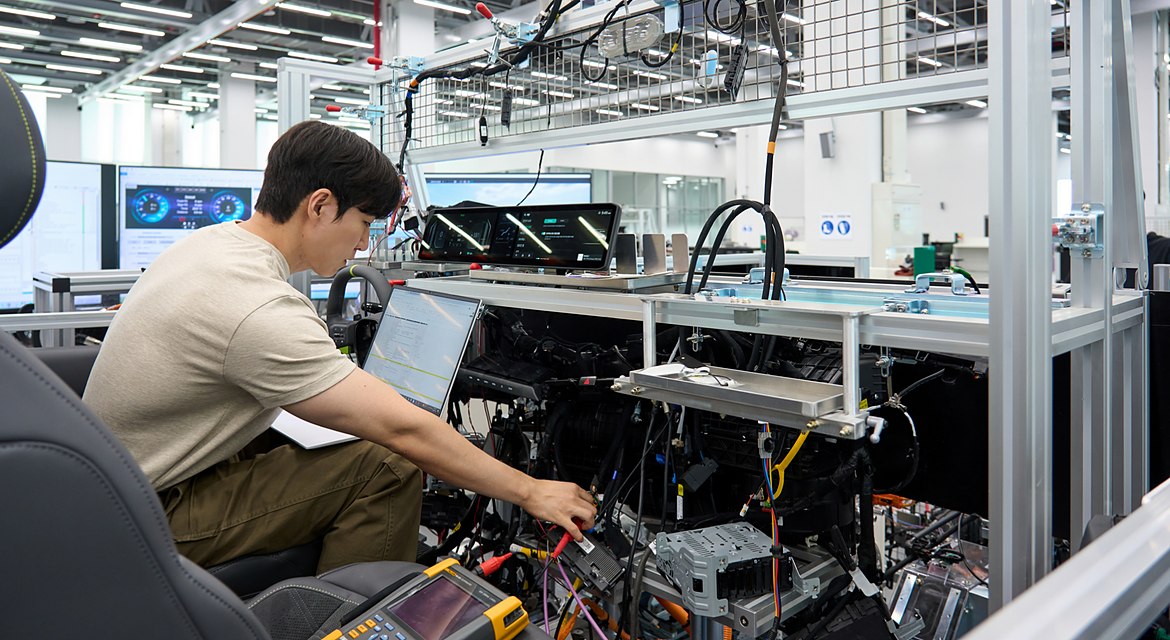
Engineer validates vehicle functions and electronic control systems using a full-scale wire-car test bench at NOVA Lab.

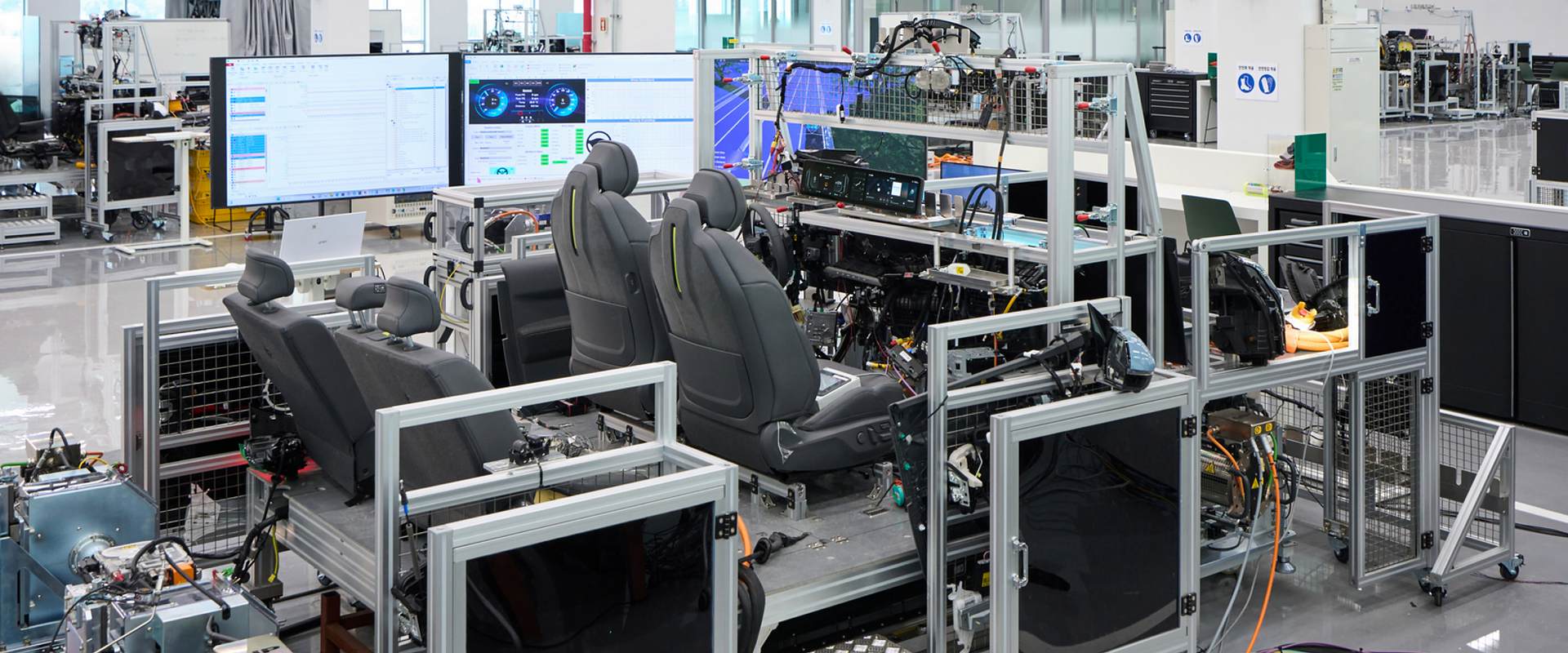
As vehicles become increasingly software-defined, validating hundreds of controllers, thousands of signals and complex electronic functions before prototype assembly is more important than ever. At Hyundai Motor and Kia's NOVA Lab, engineers use full-scale wire-car test benches to identify potential issues across a vehicle's electrical architecture before a vehicle body is even built.

Building Confidence in Vehicle Software

Modern vehicles are powered not only by engines and batteries, but also by highly complex electronic systems.


A typical vehicle contains hundreds of controllers responsible for propulsion, infotainment, connectivity, safety and Advanced Driver Assistance Systems (ADAS). While each controller may function correctly on its own, problems often emerge when these systems begin communicating and operating together. A single software conflict or communication error can affect multiple vehicle functions and may not become apparent until late-stage development.


To address this challenge, Hyundai Motor and Kia operate the NOVA Lab (Next-generation Open Validation & Automation Lab) at the Namyang Research and Development (R&D) Center. Here, engineers validate a vehicle's complete electrical architecture before a physical prototype is assembled, helping identify approximately 150 to 200 issues during development.

Building the Vehicle Before the Vehicle Exists

At the center of NOVA Lab is the wire-car test bench.


There is no vehicle body, no doors and no interior. Instead, hundreds of controllers, wiring harnesses and electronic components are physically connected exactly as they would be inside a production vehicle. The result is a complete electrical and electronic system without the vehicle itself.


Wire-car validation was introduced as vehicle software and electronics grew increasingly complex. Traditional testing focused on individual controllers and subsystems, but engineers needed a way to evaluate how entire vehicle systems performed together before prototype assembly. Hyundai Motor and Kia first introduced wire-car validation in 2019 and later expanded the concept into today's NOVA Lab.


For some vehicle programs, engineers connect 300 to 500 controllers through approximately 500 wiring connectors, creating one of the earliest opportunities to evaluate a vehicle's complete electronic architecture.

Engineer validates vehicle functions and electronic control systems using a full-scale wire-car test bench at NOVA Lab.
Added to
Media Cart
Engineer validates vehicle functions and electronic control systems using a full-scale wire-car test bench at NOVA Lab.
1 photos
Engineer validates vehicle functions and electronic control systems using a full-scale wire-car test bench at NOVA Lab.
Added to
Media Cart

Validating Hundreds of Controllers as One System

The NOVA Lab evaluates four key areas: electrical circuit integrity, communication between vehicle controllers, functional performance and diagnostic system response. Engineers verify not only that controllers can exchange information, but also that signals are transmitted correctly, delivered at the right timing and handled appropriately when faults occur.


Early development testing frequently uncovers communication failures, logic conflicts, abnormal power consumption and other system-level issues that may be difficult to identify through component-level testing alone. Resolving such issues before prototype construction helps improve software maturity and development efficiency.

Simulating the Road Before the Road Test

Because a wire-car has no physical body, NOVA Lab uses advanced simulation technologies to recreate real-world operating conditions.


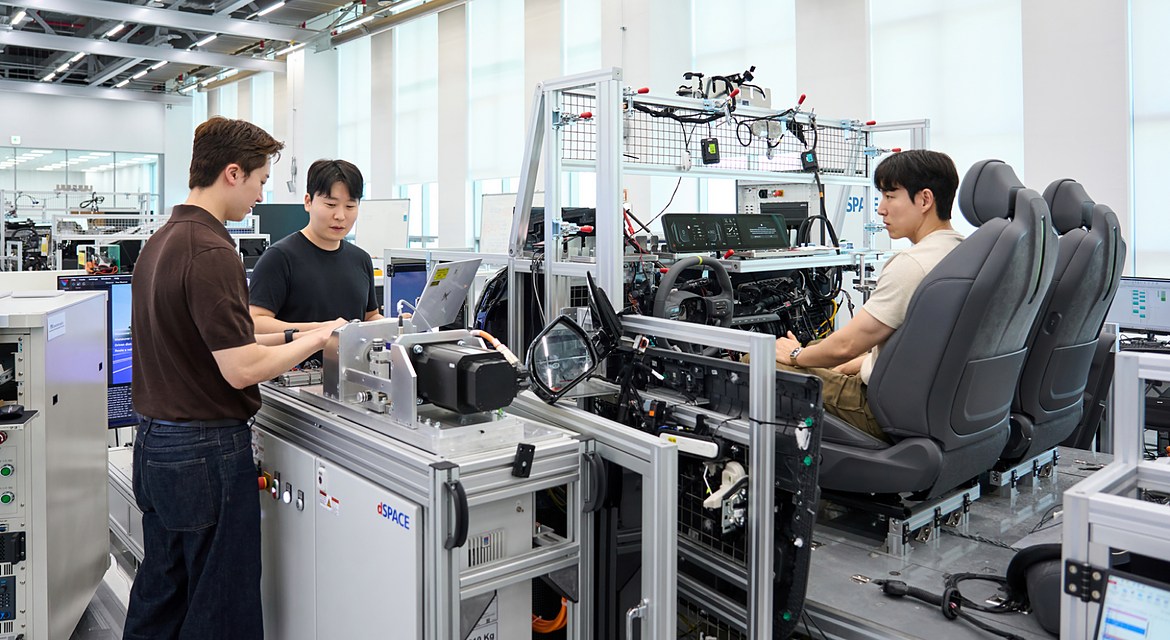
A proprietary Torque Wheel Dynamometer that combines a Hyundai Motor and Kia-developed drive load unit with a compact dynamometer.


The wire-car uses a proprietary Torque Wheel Dynamometer that combines a Hyundai Motor and Kia-developed drive load unit with a compact dynamometer. The system enables engineers to simulate how a vehicle behaves under acceleration, deceleration and driving loads, helping validate speed-dependent functions before a prototype ever reaches the road.

A Virtual Environment for ADAS Validation

One of NOVA Lab's most advanced capabilities is its ADAS simulation environment.


Using hardware-in-the-loop (HIL) technologies, vehicle behavior and communication states are calculated in real time. Virtual road imagery is projected into vehicle cameras, while Radar Target Simulators (RTS) generate synthetic traffic targets for radar sensors. Together, these technologies create a virtual driving environment without requiring a physical vehicle prototype.


Engineers can validate features such as Smart Cruise Control (SCC), Blind-Spot Collision Warning (BCW), Lane Following Assist (LFA), Lane Keeping Assist (LKA) and Forward Collision-Avoidance Assist (FCA) before the vehicle ever reaches a proving ground. In effect, the vehicle can "see" a virtual road and react to virtual traffic long before it encounters real-world conditions.

Engineer validates vehicle functions and electronic control systems using a full-scale wire-car test bench at NOVA Lab.
Added to
Media Cart
Engineer validates vehicle functions and electronic control systems using a full-scale wire-car test bench at NOVA Lab.
1 photos
Engineer validates vehicle functions and electronic control systems using a full-scale wire-car test bench at NOVA Lab.
Added to
Media Cart

Preparing for the SDV Era

As Hyundai Motor and Kia continue their transition toward software-defined vehicles (SDVs), vehicle architectures are becoming increasingly centralized and software-driven. Vehicle networks are evolving from CAN-based communication toward high-speed Ethernet, while electrical systems are expanding beyond conventional 12 V architectures toward next-generation 48 V systems.


To support these changes, NOVA Lab has expanded its validation capabilities to include Ethernet-based communication environments, 48 V power systems and integrated power-supply equipment capable of reproducing low-voltage, overvoltage and other real-world electrical conditions. The facility also supports validation of over-the-air (OTA) software updates and is exploring AI-assisted technologies capable of identifying anomalies from continuously collected vehicle data.


NOVA Lab is also supporting validation of future robotaxi platforms. Because autonomous mobility systems must operate without a human driver, critical functions such as braking and steering require redundant control architectures capable of maintaining safe operation even if a controller fails. The facility serves as a validation platform for these redundancy strategies as well as enhanced cybersecurity systems designed for next-generation autonomous vehicles.

Software-defined vehicles are designed to continuously deliver greater convenience to customers through technologies such as over-the-air updates, Our goal at NOVA Lab is to improve software quality early in development so customers experience only the benefits of an evolving vehicle, not the disruptions that can result from quality-related issues.

Sang Yeon Kim

Senior Research Engineer of the Pilot Electronic Control Development Team.

The Bigger Picture

Each facility featured in this series addresses a different challenge within modern vehicle development, yet all share the same objective: solving problems digitally before solving them physically.


The Driving Simulator reduces reliance on extensive physical testing. The Digital Measuring Center transforms dimensional quality into measurable data. The Additive Manufacturing Solution Center accelerates how parts are designed and produced. Meanwhile, NOVA Lab validates a vehicle's electrical nervous system before the vehicle itself exists.


Together, these facilities demonstrate how Hyundai Motor and Kia are transforming vehicle development from a prototype-intensive process into a digital-first engineering ecosystem. As the industry moves toward software-defined vehicles, this combination of simulation, measurement, additive manufacturing and system validation is helping accelerate innovation while strengthening quality from the earliest stages of development.

This article is part of a series on Hyundai Motor Group’s digital R&D infrastructure at the Namyang Research and Development Center. Four facilities — the Driving Simulator, Digital Measuring Center, Additive Manufacturing Solution Center and NOVA Lab — exemplify Hyundai Motor and Kia’s transformation from prototype-intensive development to digital-first validation, accelerating innovation while elevating quality and performance standards.


Daehyun Shin
daehyun.shin@hyundai.com
Global PR Contents · Hyundai Motor Company


Disclaimer: Hyundai Motor Group believes the information contained herein to be accurate at the time of release. However, the company may upload new or updated information if required and assumes that it is not liable for the accuracy of any information interpreted and used by the reader.


About Hyundai Motor Group

Hyundai Motor Group is a global enterprise that has created a value chain based on mobility, steel, and construction, as well as logistics, finance, IT, and service. With about 250,000 employees worldwide, the Group’s mobility brands include Hyundai, Kia, and Genesis. Armed with creative thinking, cooperative communication and the will to take on any challenges, we strive to create a better future for all.


More information about Hyundai Motor Group can be found at: http://www.hyundaimotorgroup.com or Newsroom: Media Hub by Hyundai, Kia Global Newsroom, Genesis Newsroom


Back to the list Editorials

Continue reading