

Hyundai Motor Group brings
AI Robotics to life at the CES 2026
8 minute read
January 07, 2026
Hyundai Motor Group(HMG) is showcasing its public exhibition at CES 2026 under the theme: “Partnering Human Progress”. Following our announcement of a human-centered AI Robotics strategy at Media Day, we are unveiling a range of our core AI Robotics technologies at CES, a global stage for innovators.
Robotic innovation in every corner
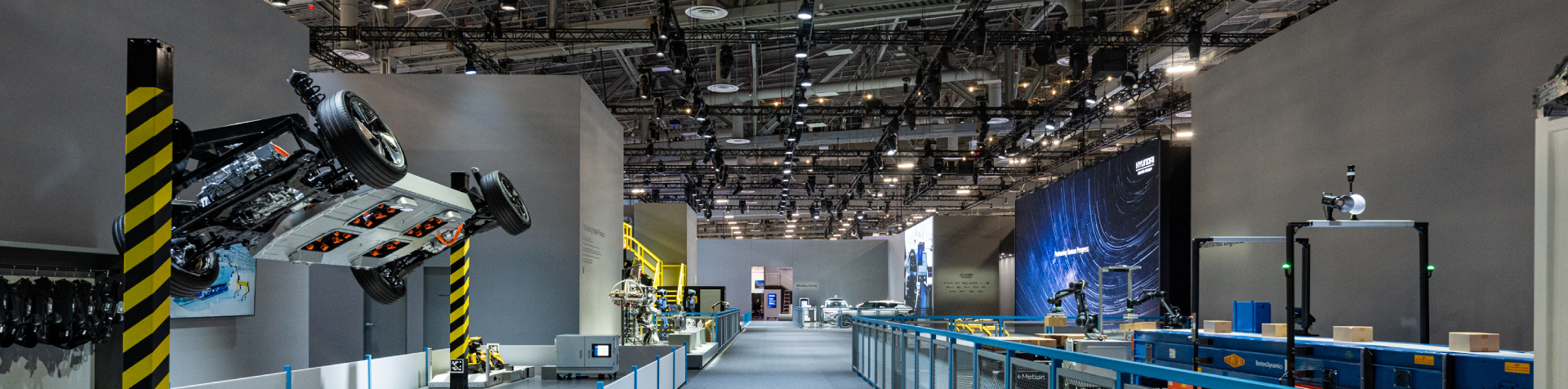
This exhibition is designed to let visitors experience firsthand how AI Robotics can bring meaningful change and innovation to everyday life. Across six dedicated zones, visitors can explore and experience the development process and technologies. From human-robot collaboration to robot-to-robot collaboration and the integration of robots with mobility technologies, we showcase the essence of human-centered AI Robotics—supporting people from working environments to daily life.
Tech Lab: Atlas and Spot demonstrate their skill
At the Tech Lab located at the center of the booth, visitors can explore Boston Dynamics’ ongoing journey of experiments and challenges to create robotics that contribute to everyday life. Designed as a research lab concept, the exhibition space features the humanoid robot Atlas and the quadruped robot Spot, both performing processes of self-learning and testing.
First, meet Boston Dynamics’ Atlas in two versions: the ‘Atlas prototype’ and the ‘Atlas product’ model. The Atlas prototype, first unveiled in 2024, was built to test core functions required for commercialization. Equipped with joints that rotate 360 degrees, it enables natural walking and efficient, stable movements, performing fully autonomous actions in work environments. In October 2025, it successfully completed pilot testing at Hyundai Motor Group’s Meta Plant America (HMGMA). Atlas repeatedly performs sequencing tasks - picking up automotive parts and aligning them in a different rack - within automotive assembly processes. Through this process, Atlas accumulates training data to continuously refine its capabilities.
Building on the Atlas prototype, we introduce a new model with enhanced efficiency and stability - the Atlas product. Leveraging Boston Dynamics’ extensive experience, Atlas product is capable of autonomous learning and adapting to any work environment, maximizing productivity in real manufacturing settings. This version features 56 DoFs(degrees of freedoms), allowing full joint rotation, and offers 360-degree vision through an integrated camera. It also boasts a maximum payload capacity of 50 kg (approximately 110 lbs), water and dustproof, and an autonomous battery-swapping function for more efficient operation. These advancements enable Atlas to learn and adapt to diverse environments and therefore is expected to significantly improve manufacturing efficiency. Hyundai Motor Group plans to mass-produce the Atlas and deploy it widely across its global manufacturing sites, including HMGMA and gradually expand its deployment through process-by-process validation.
Another key feature is Spot, a quadruped robot that supports site monitoring and safety by reaching areas difficult for humans to access. Capable of both autonomous and manual operation, Spot can be equipped with Enterprise Asset Management (EAM) tools to inspect facility safety and with an arm to handle various objects, even intervening in hazardous situations. Using Boston Dynamics’ dedicated Orbit AI software, we can remotely control multiple Spots, analyze data, and deliver actionable insights to our customers.
Tech Stage: innovation in the spotlight
The Tech Stage features live demonstrations and presentations highlighting the latest AI Robotics innovations from Boston Dynamics, including Atlas and Spot, alongside HMG Robotics LAB’s MobED. Each presentation puts a specific theme forward to introduce diverse robotics innovation, and explains each robot’s purpose, capabilities, and behind-the-scenes stories of its development. Visitors can enjoy Spot’s synchronized performances, as well as demonstrations of MobED's autonomous driving and live performance.
AI Robotics innovation empowering everyday moments
Visitors get an inside look at how Hyundai Motor Group is designing and creating everything to enable greater freedom of movement and enhance everyday convenience through safe and proven AI robotics technologies across mobility, work, and leisure.
1. Enhanced Living: AI Robotics assist with daily life
In the Enhanced Living Zone, mass-produced MobED (Mobile Eccentric Droid) by Hyundai Motor Group’s Robotics Lab showcases how AI Robotics naturally integrates into everyday spaces, making customers’ lives more convenient and enriching.
MobED is an advanced mobility robot platform with four independently controlled wheels and a unique eccentric mechanism. With its DnL(Drive-and-Lift) module, MobED can smoothly navigate various terrains and remain stable even on uneven surfaces. Its driving technology ensures safe and efficient obstacle avoidance, even in crowded environments.
MobED is based on two types of platforms – each called ‘Basic’ and ‘Pro’. MobED Basic is the standard version optimized for research and development of autonomous robots. MobED Pro is a model that provides autonomous navigation. Both versions support a range of Top Module applications. Concept models showcased in this year’s CES - MobED Pick & Place, MobED Golf, and MobED Delivery are based on the Pro platform, while the MobED Urban Hopper is based on the Basic platform.
2. Effortless Driving: Where AI Robotics meets mobility
In the Effortless Driving Zone, Hyundai Motor Group presents an experience that brings AI Robotics technology with mobility. Tasks that once required human control are now automated and autonomous, with seamless connectivity extending to charging and parking.
First, the IONIQ 5 Robotaxi is equipped with a Level 4 autonomous driving system, enabling fully driverless operation within designated areas. It effectively demonstrates how the vehicle can precisely perceive its surroundings in complex urban environments, predict the movement of nearby objects, and design safe and reliable driving paths.
Complementing the Robotaxi is the Automatic Charging Robot (ACR), an innovation in charging infrastructure. Using sensors and algorithms, it alleviates the physical burden users experience when charging an Electric Vehicle (EV), and improve accessibility providing convenient charging services to anyone.
The Parking Robot carefully moves and positions vehicles even in tight spaces, changing stressful parking experience and rather creating an efficient parking environment. This technology not only makes post-driving experiences safer and more convenient but also improves parking efficiency by up to 27% in office buildings.
Human-centered AI technology elevating work life
Hyundai Motor Group is committed to building safe and efficient work environments through AI Robotics. We aim to create productive and creative industrial environments by fostering collaboration between humans and robots, as well as collaboration among robots themselves.
1. Collaborative Assembly: Human-robotics synergy
At the Collaborative Assembly zone, visitors can see how AI Robotics help make factories more efficient while enhancing the quality of life for those who work there.
One of the main highlights of the Collaborative Assembly zone is the X-ble Shoulder, an industrial wearable robot that increases work efficiency by assisting the upper-arm while lowering injury risk and fatigue. Weighing just 1.9 kg and offering a wide arm range of 0–180°, it reduces shoulder joint loads by up to 60% during overhead tasks.
Spot AI Keeper and the Battery Quick Changer, illustrate how AI Robotics increasingly contribute to quality detection and management and improve operational efficiency. Spot AI Keeper, based on Boston Dynamics’ Spot, helps maintain optimal quality by detecting and reporting assembly defects during the manufacturing process, and is currently being utilized at Hyundai Motor Group Innovation Center Singapore(HMGICS) and HMGMA. The Battery Quick Changer automatically replaces Spot's battery upon docking, effectively minimizing downtime.
2. Streamlined Logistics: Teamwork in robotics
At the Streamlined Logistics section, Hyundai Motor Group demonstrates how real-world logistics automations benefit from AI-driven innovation. Robots take on highly intensive tasks to reduce physical strain on workers, and at the same time, significantly enhance efficiency and safety in logistics operations.
Live demonstrations of Stretch, the Collaborative Robot (Cobot), and the Autonomous Mobile Robot (AMR) working together to perform logistics tasks—unloading, loading, and transporting—highlight collaboration for a flexible logistics and manufacturing environment. Stretch is an autonomous, mobile robot designed for warehouse automation. It can automatically detect and unload packages, making it easy to operate even in containers or trailers. By performing highly intensive unloading tasks, Stretch helps reduce the physical burden on workers.
Cobots that work with Stretch are designed to safely operate and collaborate in the same space as human workers. Cobots perform palletizing tasks by using a six-axis articulated arm to stack boxes or parts on industrial pallets according to a defined pattern.
Completing the scene, the Autonomous Mobile Robot (AMR) transports pallets completed by the Cobots, continuing the flow of the entire demonstration. Equipped with LiDAR sensors and 3D depth cameras, it uses SLAM (Simultaneous Localization and Mapping) technology to autonomously perceive its surroundings and obstacles, selecting the safest and most efficient route for movement. At HMGMA, this autonomous logistics robot technology is actively utilized to enable smooth and efficient logistics operations.
AI Robotics, From the Lab to Everyday Life
Through this exhibition, Hyundai Motor Group has demonstrated its AI Robotics innovations that will be even more deeply integrated into our daily lives. From industrial sites and to everyday life, robots powered by safe and validated technologies assist people and drive human progress. Together with leading AI companies worldwide—and with you—Hyundai Motor Group will continue to shape a human-centered future where AI Robotics and humanity collaborate and coexist in harmony.
Follow @hyundai on Instagram for the latest robotics news and highlights.